


RFID is rapidly moving from niche innovation to production-floor reality. While a
recent workshop hosted by Mark Andy and Talkin’ Things in Poland showcased
how seamlessly smart labels are being integrated into live print workflows, the
implications are beginning to resonate closer to home as South African converters
cautiously step into the space.
RFID may be gaining renewed momentum, but for Mark Andy, it’s a space the company has been actively developing for decades. As far back as 2006, the OEM received a FlexoTech International Innovation award for RFID inline solutions, underlining its early investment in integrating tag insertion, encoding and verification directly into narrow web production.
Two decades on, that long-term commitment is beginning to align with broader market readiness.
More than 70 participants from Poland, France, Spain, Bulgaria, Romania and Slovenia gathered in Warsaw for
the Smart Labels: RFID Technology workshop, where the conversation around smart labelling shifted decisively from
concept to application.
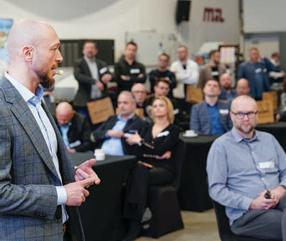
Hosted in partnership with Talkin’ Things at Mark Andy’s European Technology Centre, the event brought together a cross-section of the value chain, from label and packaging manufacturers to converters, brand owners and supply chain specialists.
What set the workshop apart was its practical focus. Attendees were given a front-row view of RFID in action, including a visit to Talkin’ Things’ manufacturing facility and a live demonstration of RFID-enabled label production on a Mark Andy Evolution Series E5 press. The message was clear: RFID is no longer an emerging technology – it is production ready and increasingly integral to modern labelling strategies. Opening the programme, Lukasz Chruslinski, Mark Andy’s European sales manager, outlined the key forces accelerating adoption, from the growing demand for accurate product
identification to the automation of logistics processes and the regulatory momentum behind initiatives such as the
Digital Product Passport. As traceability requirements tighten, smart labels are rapidly becoming a foundational element
of supply chain infrastructure rather than a value-added extra.
RFID already plays a critical role across applications including inventory management, anti-counterfeiting and real time tracking. However, its integration into label production is where the technology is gaining real traction. The ability to embed intelligence directly into labels, without disrupting production efficiency, is unlocking new opportunities for converters and brand owners alike.
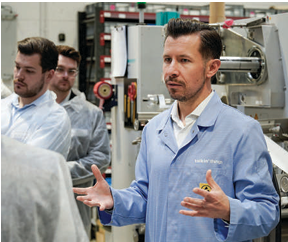
A deeper dive into the technology came from Jacek Terski, sales and business development director at Talkin’ Things, who
unpacked the design and manufacturing of RFID tags. With operations spanning more than 40 countries, Talkin’ Things
has developed an extensive portfolio of antenna designs and application-specific solutions. Jacek explained how RFID tags,
comprising an antenna, integrated circuit and substrate, use radio waves to transmit data, effectively turning labels into
dynamic carriers of information.
This capability is transforming how products are tracked and managed throughout their lifecycle. By embedding RFID
directly into labels, businesses gain fast, contactless access to data at every stage of the supply chain, improving visibility,
efficiency and security
The theory was reinforced with a guided tour of Talkin’ Things’ Warsaw facility, where participants followed the full
production process, from design and prototyping through to manufacturing and rigorous testing. Producing hundreds of
millions of RFID and NFC tags annually, the facility highlights the scale at which the technology is already operating. Its
integrated R&D and production model also enables rapid innovation, ensuring solutions keep pace with evolving market
demands.
Back at the Technology Centre, live press demonstrations showcased how seamlessly RFID can be incorporated into
label production. Running on the Evolution Series E5, the demonstrations illustrated the application of RFID tags within
a single workflow, maintaining both print quality and efficiency. From a technical standpoint, Paul Bouwer, director of
SArepco and Mark Andy’s representative in South Africa, highlights the sophistication behind these systems.
‘What makes Mark Andy stand out is that they’ve engineered the entire RFID workflow into the press,’ he says. ‘You’re not
dealing with separate processes; it’s one continuous system that ensures the tag is inserted, encoded and verified before
it leaves the press.’
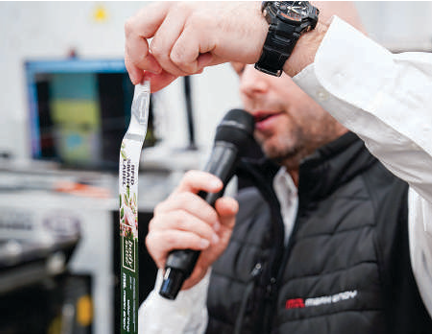
Evolution Series E5 press, integrated with an RFID tag application.
This level of integration is critical in ensuring reliability at scale, particularly in applications where accuracy and traceability are non-negotiable. He adds that even downstream processes such as die cutting require careful consideration. ‘The RFID tag isn’t flat, so cutting around it requires precision. The tooling has to accommodate that without damaging the
tag. It’s not as simple as conventional die cutting.’
Years of development by Mark Andy have resulted in solutions that allow converters to adopt RFID incrementally,
aligning investment with market demand. This long-term approach reflects the company’s early recognition that RFID
would ultimately become part of the converting landscape, even if adoption has taken longer than initially anticipated.
The session concluded with an interactive Q&A, covering everything from sector-specific applications to the rollout of
RFID within global retail networks such as Decathlon and Walmart. The discussions reinforced a common theme:
successful implementation depends on collaboration across the entire value chain.
If the workshop demonstrated anything, it is that RFID has moved beyond pilot projects and proof-of-concept. It is now
firmly embedded on the press line.
SA’s measured adoption
While the technology is clearly established globally, adoption in South Africa is beginning to take shape more selectively.
According to Paul, the technology itself is no longer the barrier. ‘From a capability point of view, RFID is proven,’ he says. ‘Mark Andy can deliver a complete, inline solution, from printing and tag insertion through to encoding, verification and
finishing. It’s a fully integrated process.’
However, he notes that adoption remains closely tied to scale. ‘The only way cost comes down is with mass uptake.
As demand builds, the economics will follow and we’re already seeing pockets of adoption where the value is clear.’
This is already being reflected in the local converting landscape. Companies like Label Leaders are among a small
group of converters that have moved beyond theory into practical implementation. According to Theo Raubenheimer, director at Label Leaders, the shift is about moving up the value chain. ‘We produce
the tags ourselves. What we’re essentially doing is taking a standard label, whether blank or printed, and inserting the
inlay, which is the microchip and antenna. That transforms the label into a smart label,’ he explains.
For converters on the ground, this has translated into a more pragmatic, phased approach. Label Leaders, for example, operates a hybrid workflow that reflects the current state of the market, combining conventional printing with dedicated
RFID insertion processes, rather than relying solely on fully integrated lines. Theo adds that RFID’s strongest value lies in operational efficiency. ‘The goal is to take human error out of the process,’ he notes, pointing to applications in logistics, warehousing and supply chain automation where accuracy and visibility are critical.
Paul agrees, noting that RFID is already delivering value in targeted applications. ‘In sectors like automotive, logistics
and higher-value goods, the benefits are immediate. You get accuracy, traceability and control,’ he says. ‘That’s where
adoption is gaining real traction, and from there it will expand.’ Paul is confident that the groundwork laid by technology
providers like Mark Andy will support broader uptake. ‘They’ve invested heavily and developed the capability over many years,’ he says. ‘When the market is ready at scale, the solutions are
already there.’
Theo cuts through the noise: RFID is no longer a future-facing concept, but a competitive tool available right now. ‘If you don’t stay current with technology, you’re going to be left behind,’ he warns. The companies that will shape the next phase of South Africa’s label and packaging sector are those investing early, building in-house capability, and integrating RFID across the value chain rather than treating it as an add-on.